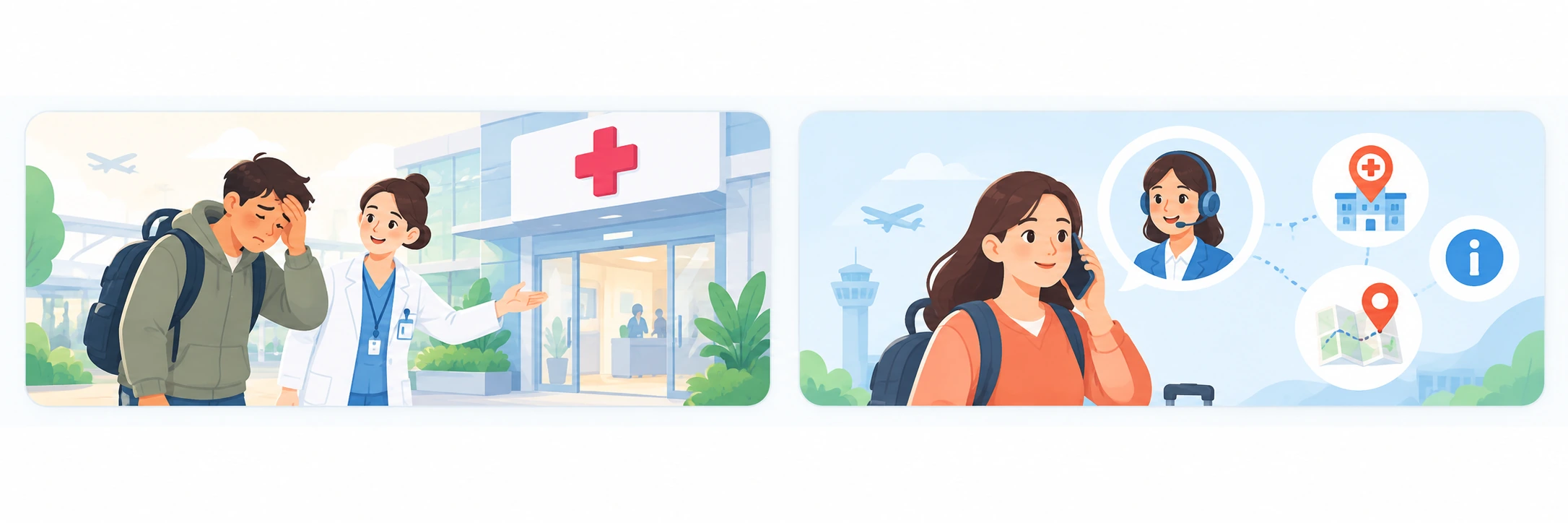
Illustration. Use the working emergency and help links above.Detailed steps
Follow these steps
1
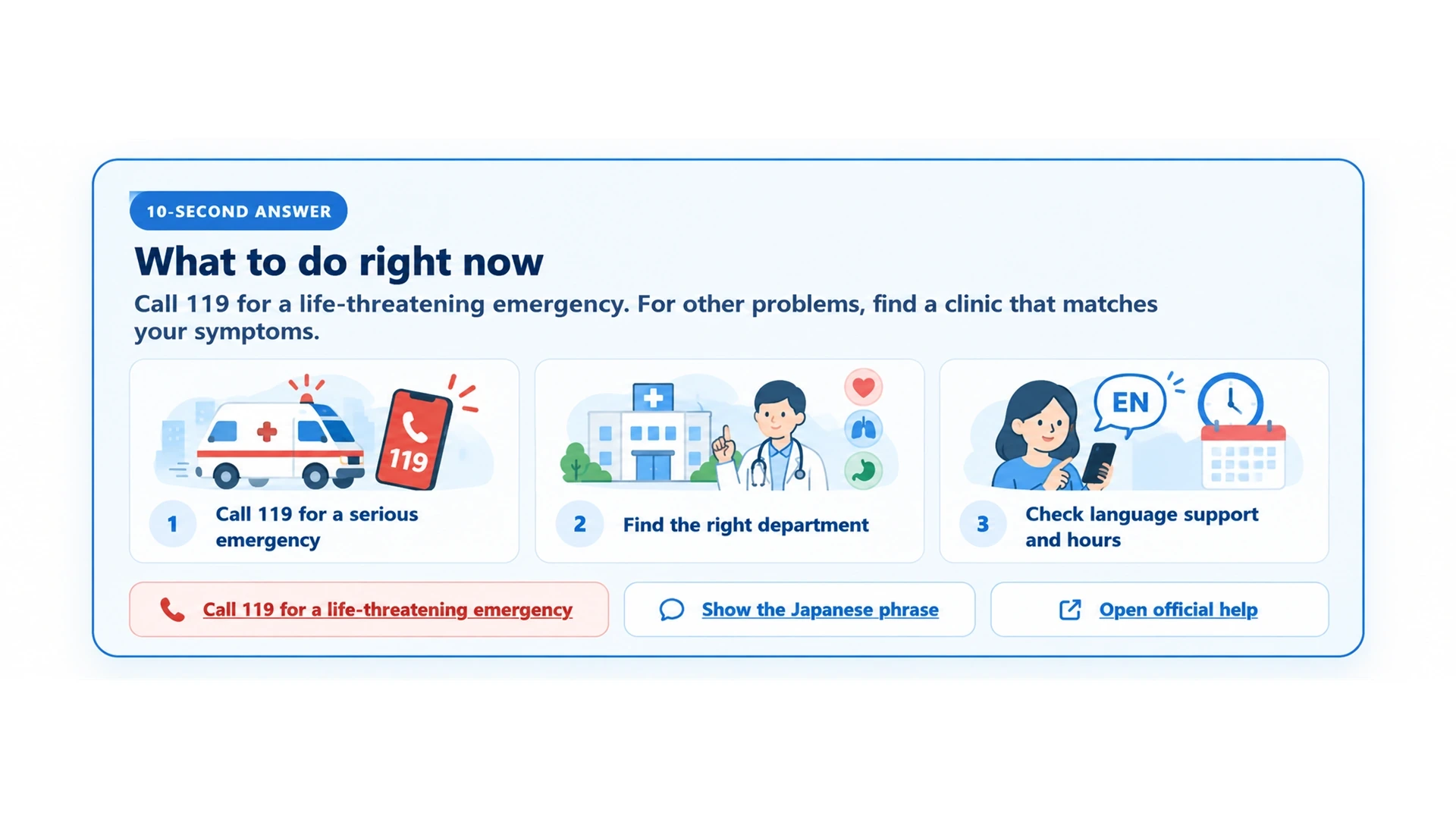
Call 119 for a serious emergency
Use 119 for severe difficulty breathing, loss of consciousness, heavy bleeding, or another life-threatening condition.
2
Find the right department
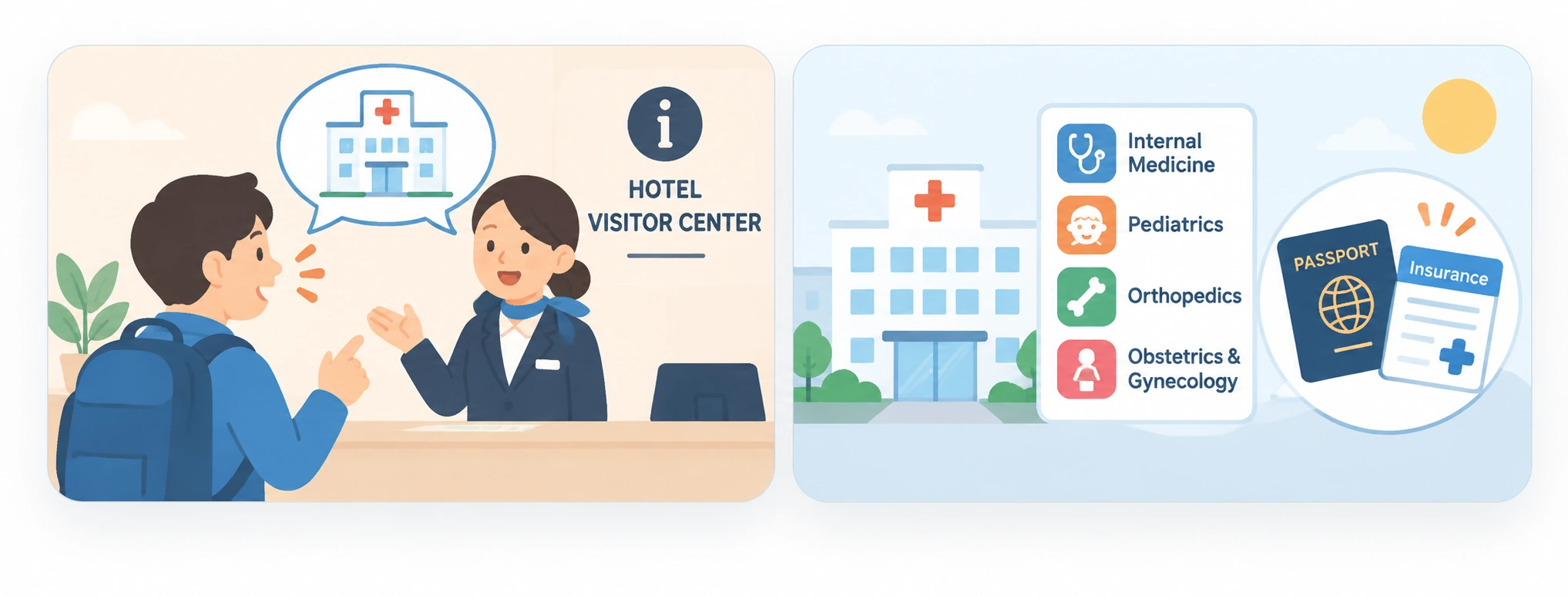
Hotels and official visitor centers can help locate a nearby clinic. Bring your passport and insurance details.
3
Check language support and hours
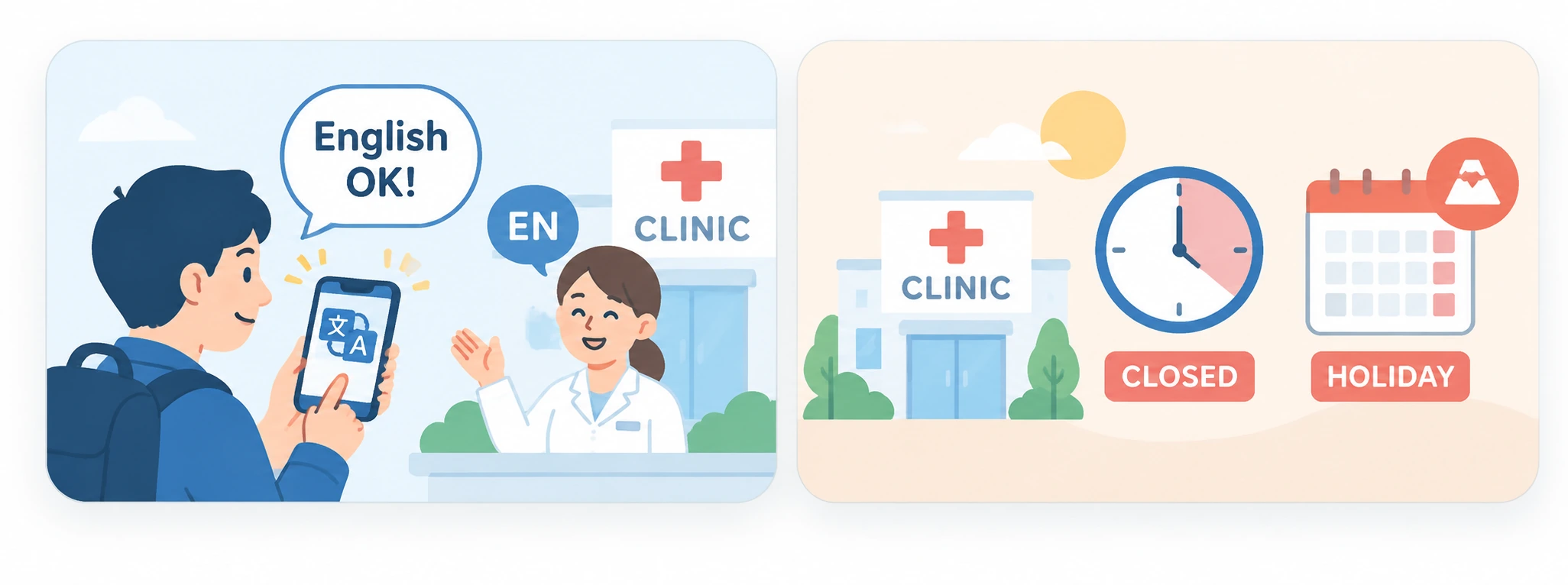
Illustration: language support is not guaranteed. Confirm it with the facility.
Many clinics close in the afternoon, at night, and on holidays. Confirm interpretation before traveling there.
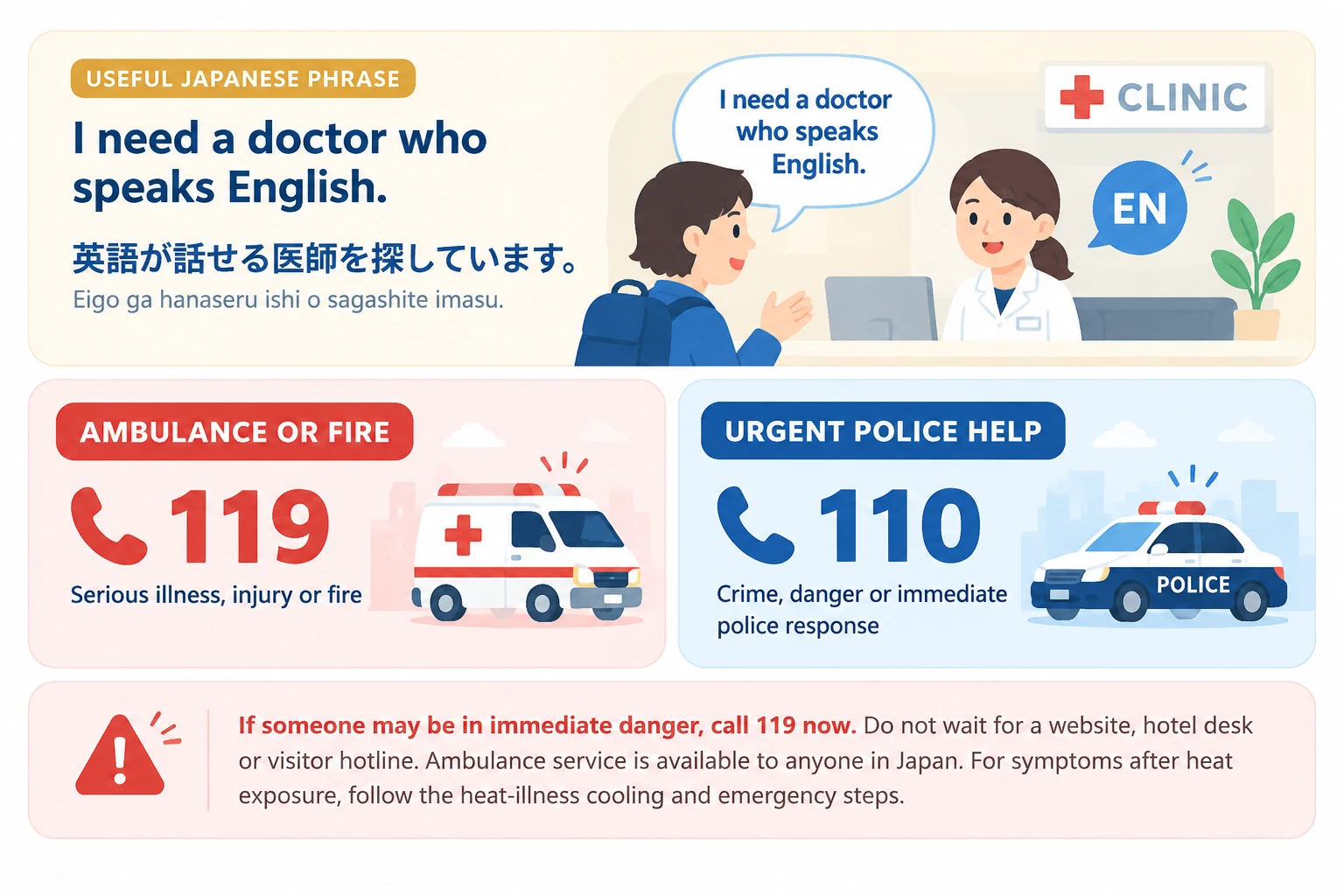
Useful Japanese phrase
I need a doctor who speaks English.
英語が話せる医師を探しています。
Eigo ga hanaseru ishi o sagashite imasu.
Use 119 for an ambulance or fire and 110 for urgent police assistance. The working phone links are below.
Ambulance or fire119Serious illness, injury or fire
Urgent police help110Crime, danger or immediate police response
If someone may be in immediate danger, call 119 now. Do not wait for a website, hotel desk or visitor hotline. Ambulance service is available to anyone in Japan. For symptoms after heat exposure, follow the heat-illness cooling and emergency steps.
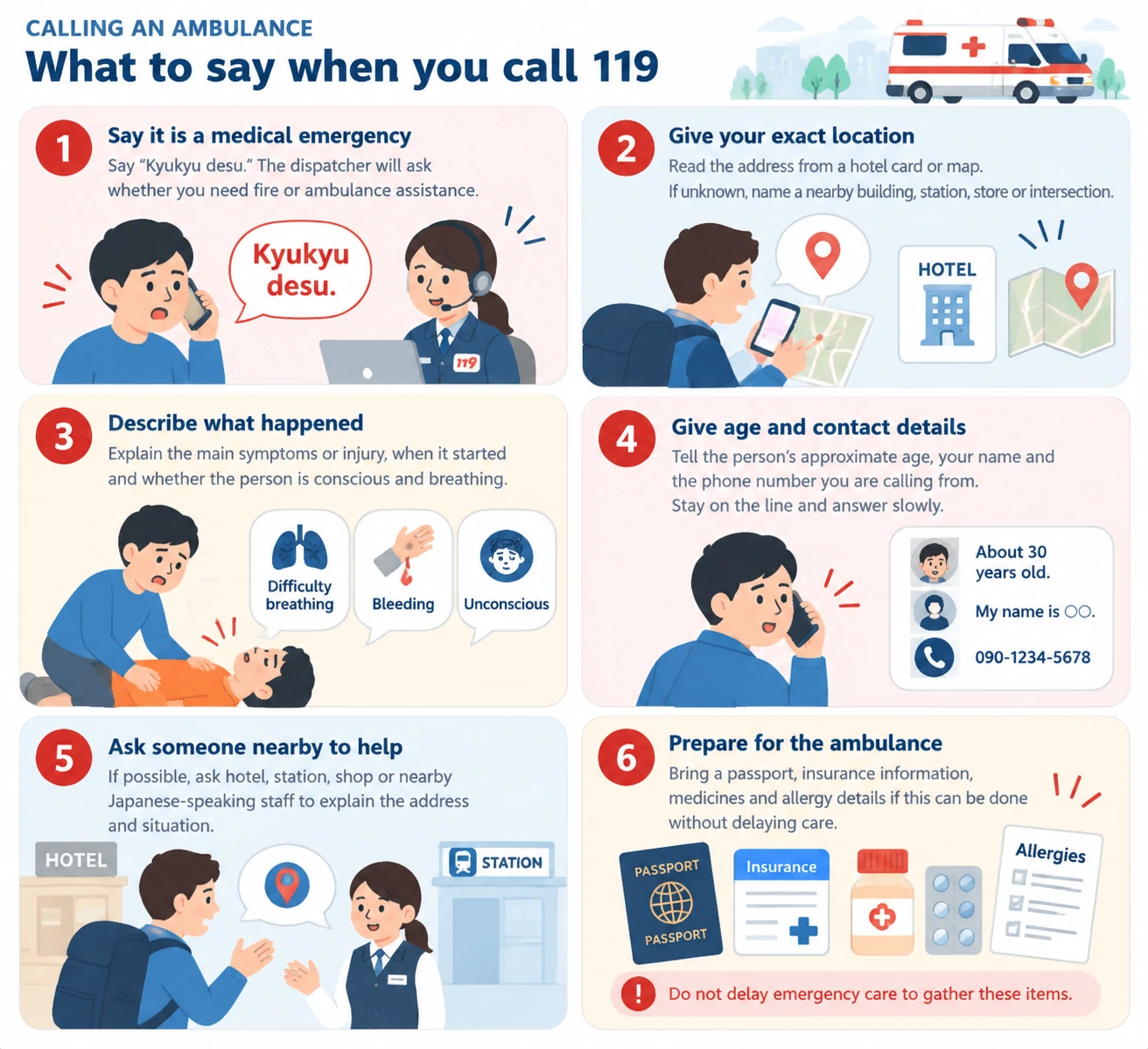
Calling an ambulance
What to say when you call 119
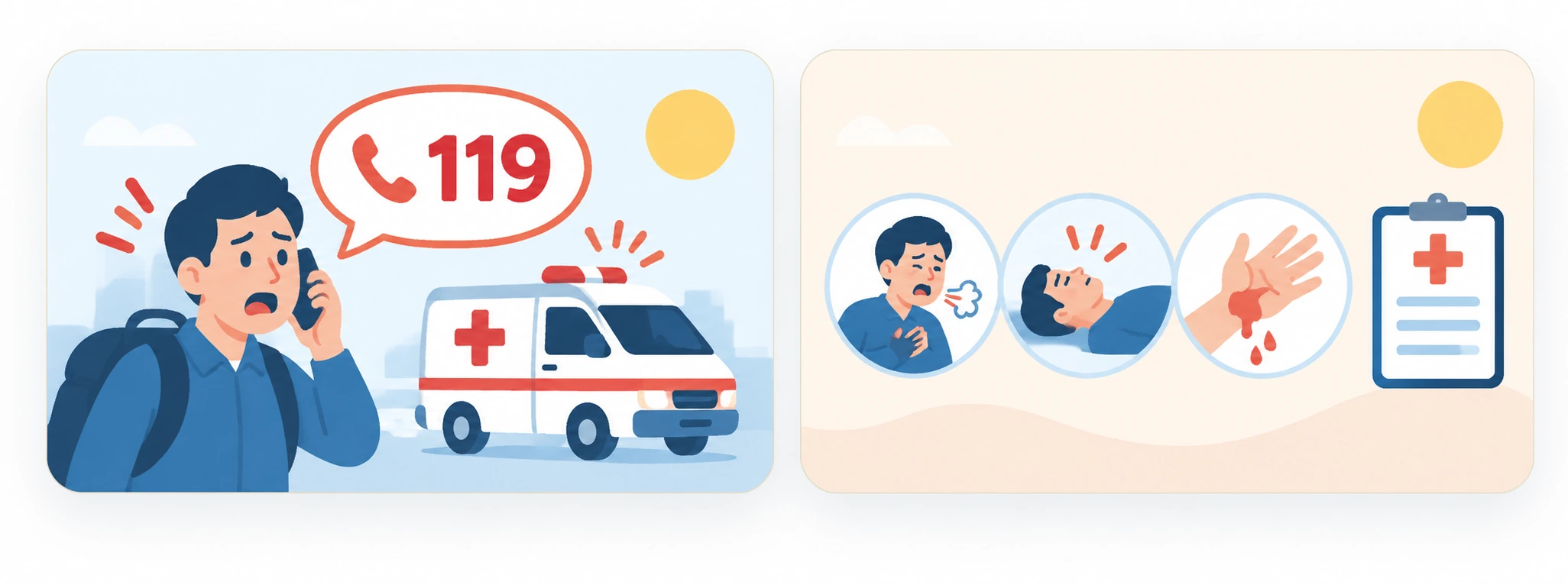
Illustration of information to provide, not a first-aid demonstration. Follow the dispatcher’s instructions.
1Say it is a medical emergencySay “Kyūkyū desu.” The dispatcher will ask whether you need fire or ambulance assistance.
2Give your exact locationRead the address from a hotel card or map. If unknown, name a nearby building, station, store or intersection.
3Describe what happenedExplain the main symptoms or injury, when it started and whether the person is conscious and breathing.
4Give age and contact detailsTell the person's approximate age, your name and the phone number you are calling from. Stay on the line and answer slowly.
5Ask someone nearby to helpIf possible, ask hotel, station, shop or nearby Japanese-speaking staff to explain the address and situation.
6Prepare for the ambulanceBring a passport, insurance information, medicines and allergy details if this can be done without delaying care.
View the care-options overviewFor non-emergency care, search first and confirm that the facility can see you.
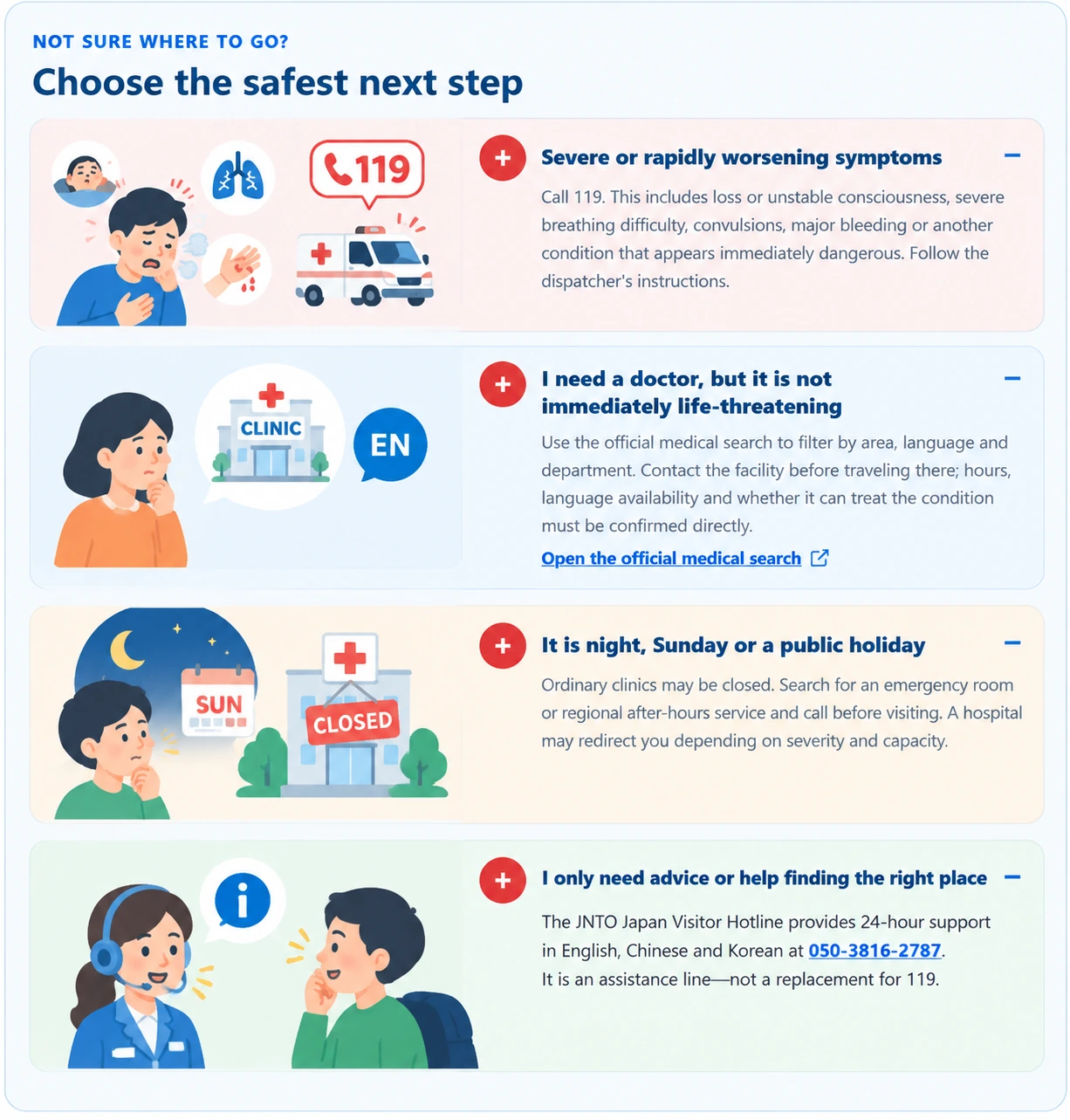
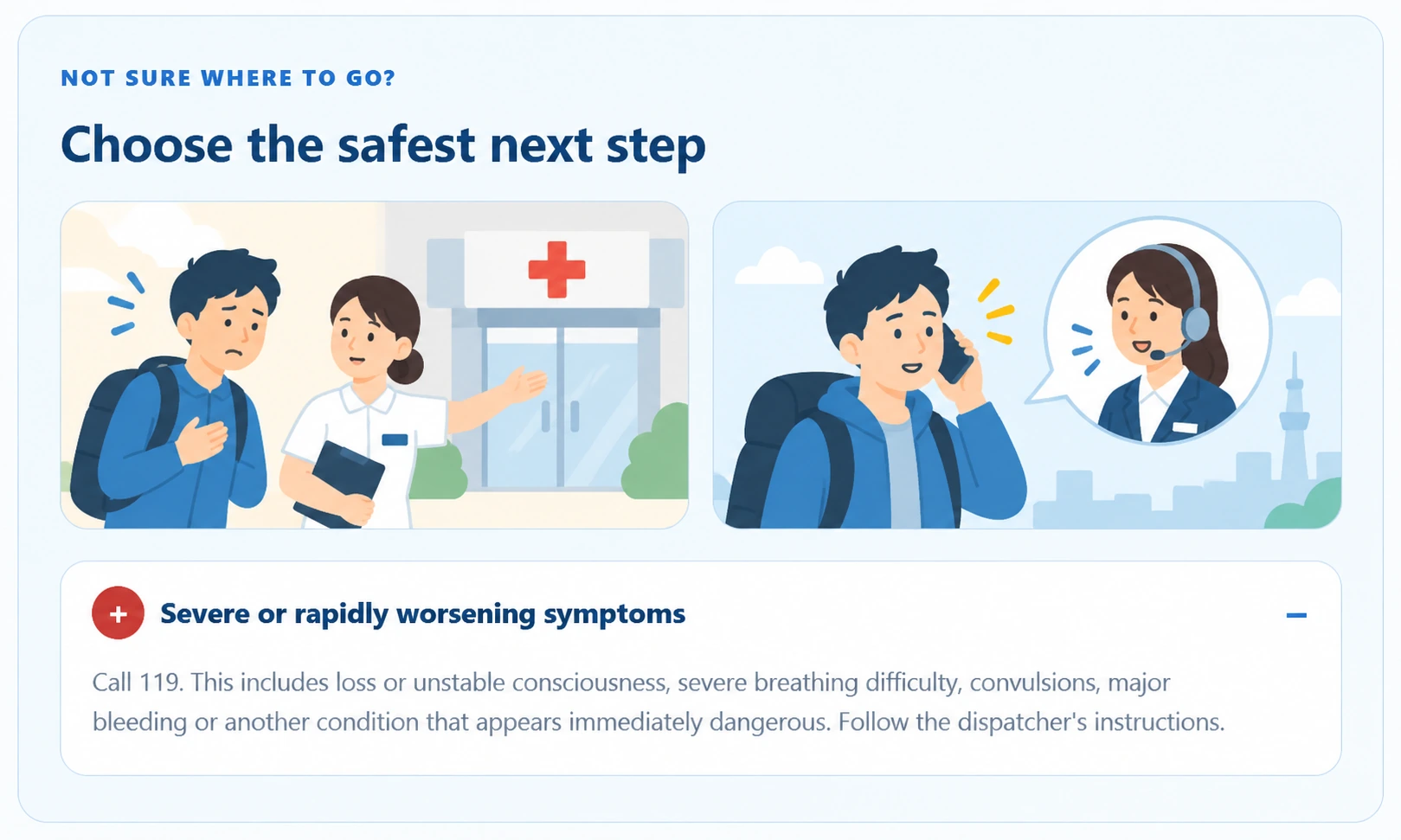
Not sure where to go?
Choose the safest next step
Severe or rapidly worsening symptoms
Call 119. This includes loss or unstable consciousness, severe breathing difficulty, convulsions, major bleeding or another condition that appears immediately dangerous. Follow the dispatcher's instructions.
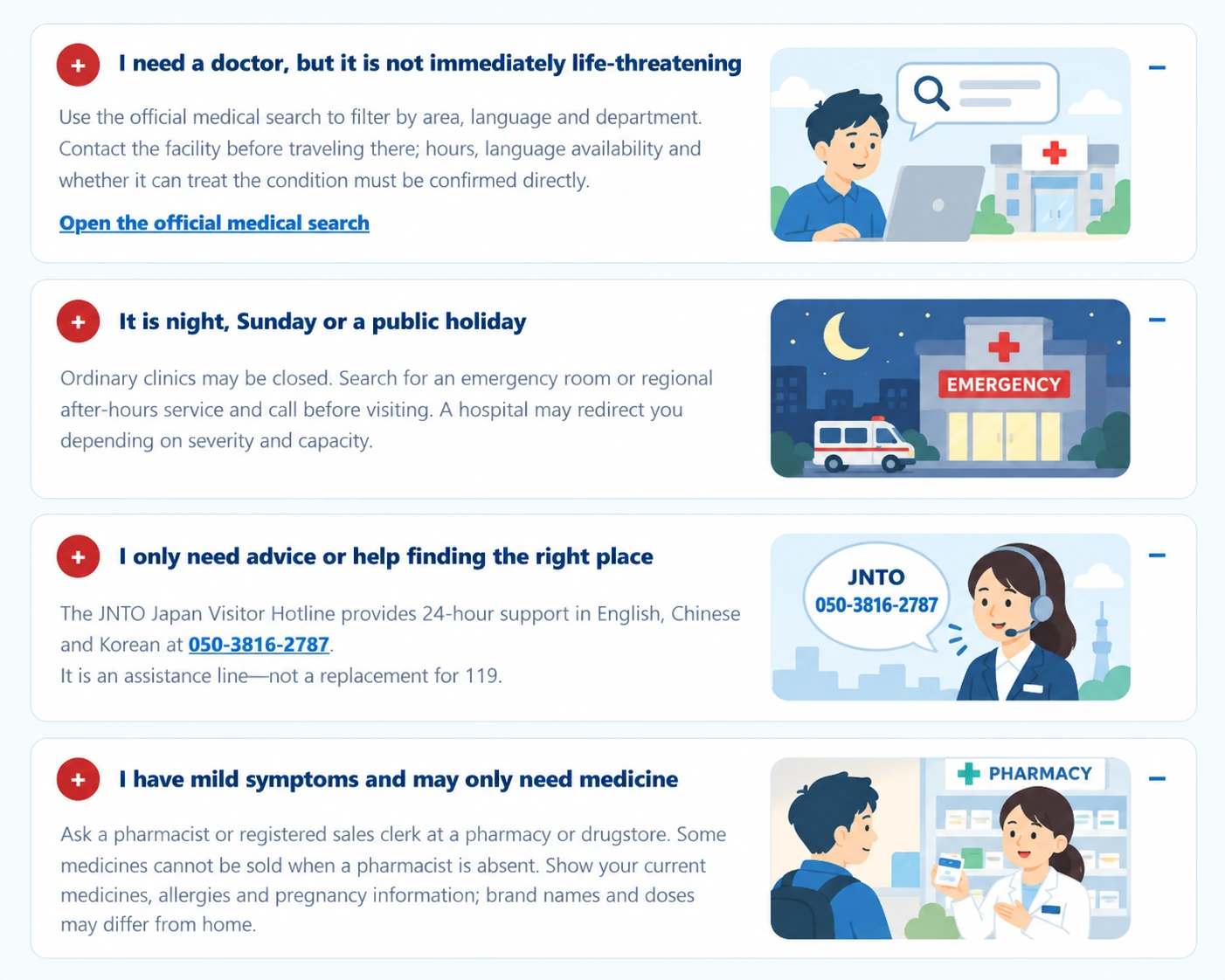
Use the text panels below for working search and telephone links.I need a doctor, but it is not immediately life-threatening
Use the official medical search to filter by area, language and department. Contact the facility before traveling there; hours, language availability and whether it can treat the condition must be confirmed directly.
Ordinary clinics may be closed. Search for an emergency room or regional after-hours service and call before visiting. A hospital may redirect you depending on severity and capacity.
I only need advice or help finding the right place
The JNTO Japan Visitor Hotline provides 24-hour support in English, Chinese and Korean at 050-3816-2787. It is an assistance line—not a replacement for 119.
I have mild symptoms and may only need medicine
Ask a pharmacist or registered sales clerk at a pharmacy or drugstore. Some medicines cannot be sold when a pharmacist is absent. Show your current medicines, allergies and pregnancy information; brand names and doses may differ from home.
WINTER ILLNESS AND HOLIDAY HOURS
Fever during your trip: confirm where you can be seen today
Example: you wake up with a fever at your hotel during the New Year holiday. Do not rely only on a map's usual opening hours. For a non-emergency visit, contact the clinic before travelling when possible and describe your symptoms. Ask whether it can see you today, whether an appointment is needed, and which entrance or arrival procedure to use.
Confirm the practical details. Give the patient's age, location, symptoms and when they started. Ask about language support, holiday reception hours and the last time you can arrive. A facility listed as open may not offer the department or language support you need.
Prepare a short symptom note. Record your temperature if measured, medicines already taken, allergies and relevant medical conditions. Bring medicine packaging or a list, identification, insurance details and a payment method. Ask hotel staff for help making the call if needed.
Plan a safe journey. After the facility confirms it can see you, check how to reach it in the current weather. Do not assume a taxi or hotel shuttle is available. If you become seriously unwell, do not keep searching for transport or walk to a clinic alone.
For severe breathing difficulty, unconsciousness or another life-threatening emergency, call 119. Do not wait for the clinic to reopen, a taxi booking or insurance approval. The emergency steps above take priority.
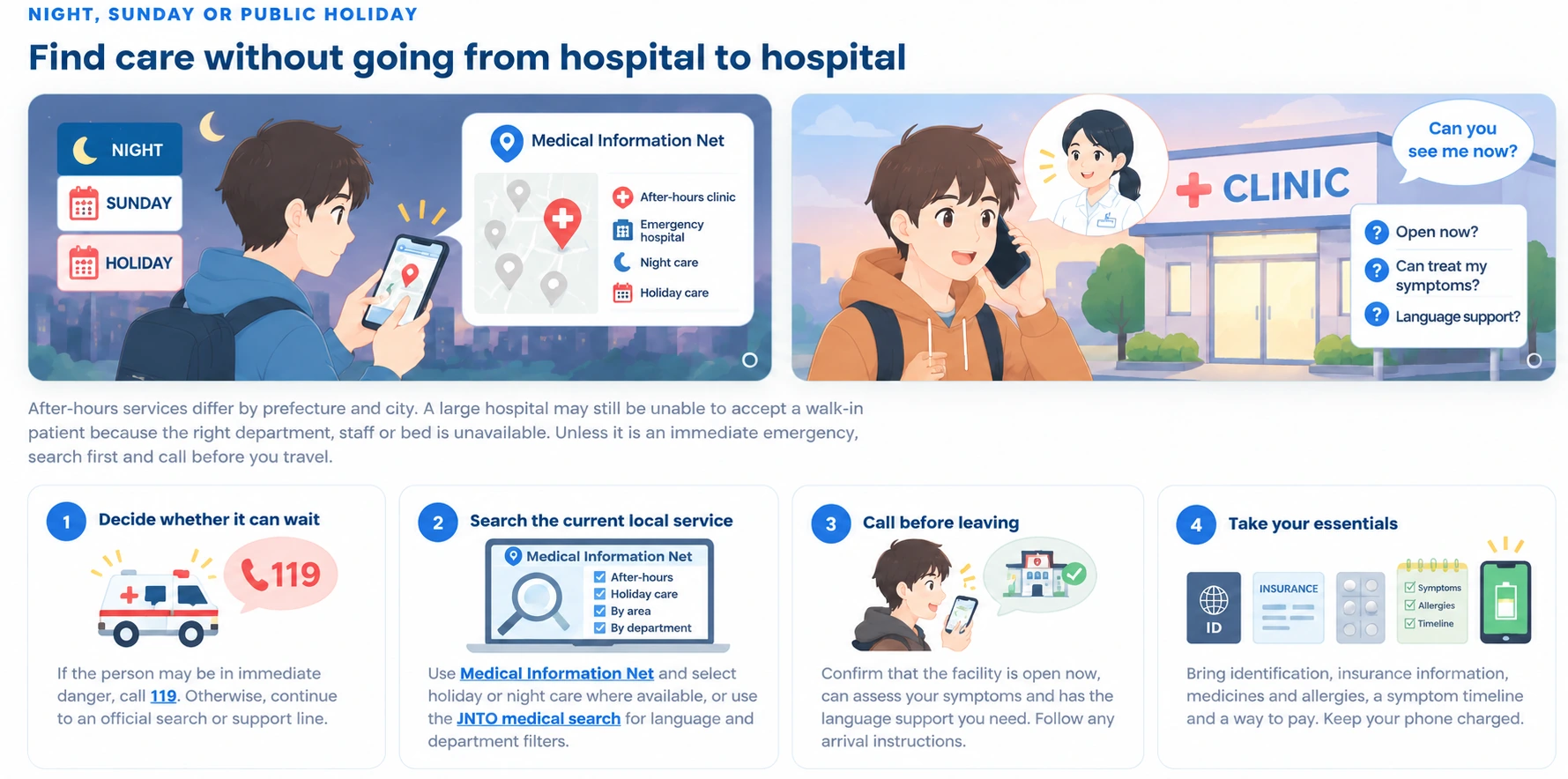
Illustrated search example, not an actual service screen. Confirm current availability by phone.
After-hours services differ by prefecture and city. A large hospital may still be unable to accept a walk-in patient because the right department, staff or bed is unavailable. Unless it is an immediate emergency, search first and call before you travel.
1Decide whether it can waitIf the person may be in immediate danger, call 119. Otherwise, continue to an official search or support line.
2Search the current local serviceUse Medical Information Net and select holiday or night care where available, or use the JNTO medical search for language and department filters.
3Call before leavingConfirm that the facility is open now, can assess your symptoms and has the language support you need. Follow any arrival instructions.
4Take your essentialsBring identification, insurance information, medicines and allergies, a symptom timeline and a way to pay. Keep your phone charged.
☎
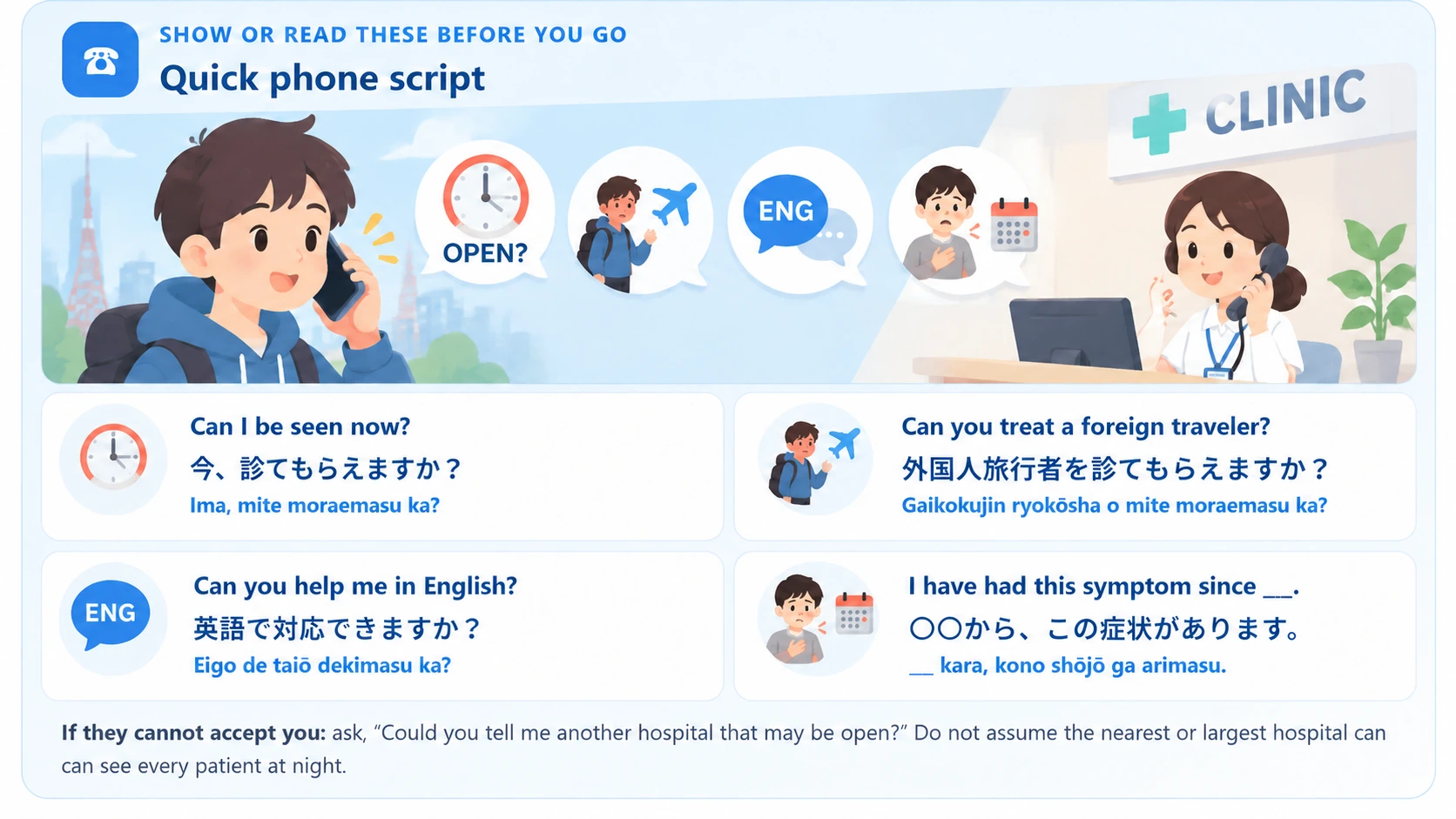
Show or read these before you go
Quick phone script
Can I be seen now?今、診てもらえますか?Ima, mite moraemasu ka?
Can you treat a foreign traveler?外国人旅行者を診てもらえますか?Gaikokujin ryokōsha o mite moraemasu ka?
Can you help me in English?英語で対応できますか?Eigo de taiō dekimasu ka?
I have had this symptom since ___.〇〇から、この症状があります。___ kara, kono shōjō ga arimasu.
If they cannot accept you: ask, “Could you tell me another hospital that may be open?” Do not assume the nearest or largest hospital can see every patient at night.
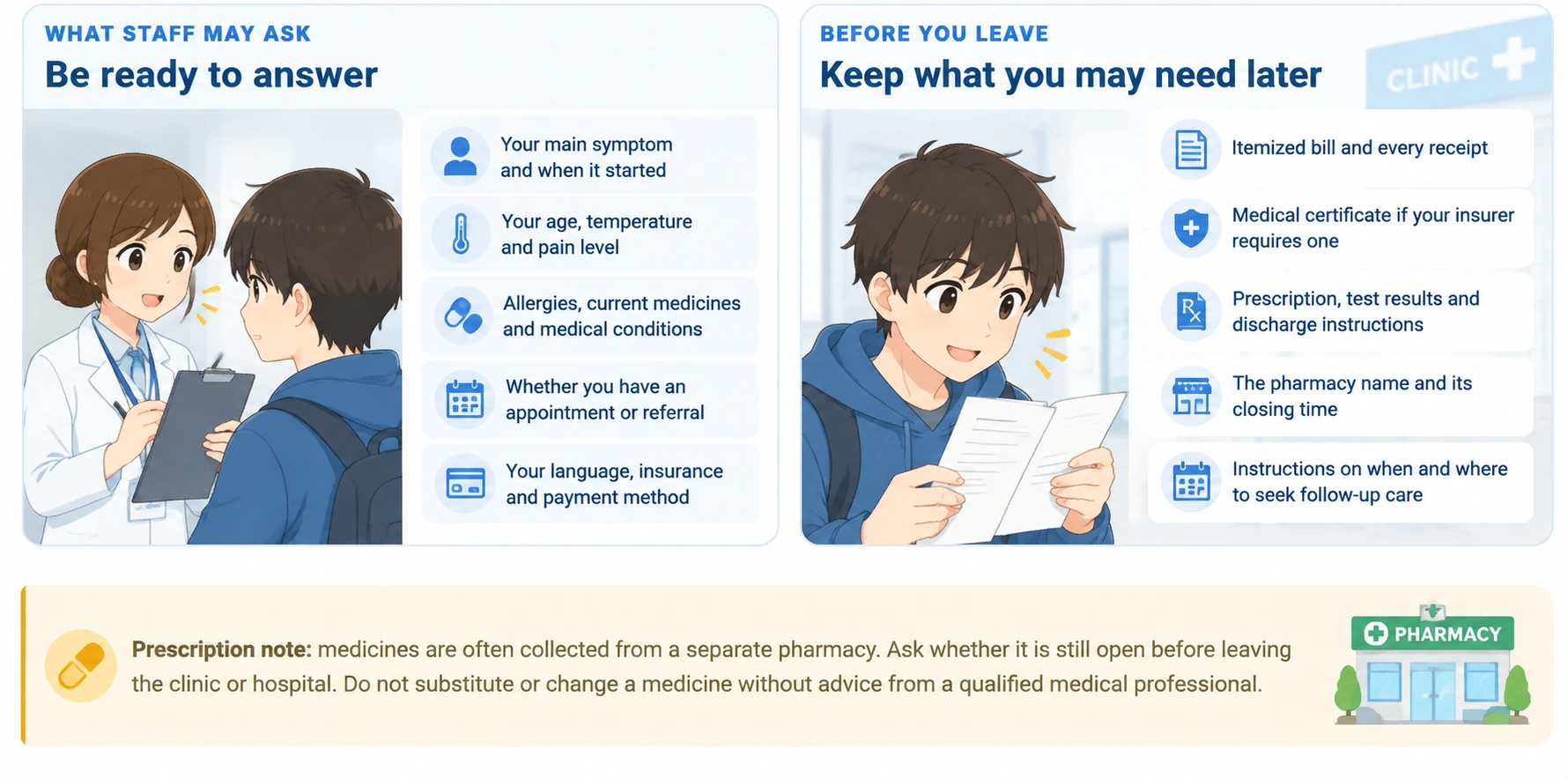
What staff may ask
Be ready to answer
Your main symptom and when it started
Your age, temperature and pain level
Allergies, current medicines and medical conditions
Whether you have an appointment or referral
Your language, insurance and payment method
Before you leave
Keep what you may need later
Itemized bill and every receipt
Medical certificate if your insurer requires one
Prescription, test results and discharge instructions
The pharmacy name and its closing time
Instructions on when and where to seek follow-up care
Prescription note: medicines are often collected from a separate pharmacy. Ask whether it is still open before leaving the clinic or hospital. Do not substitute or change a medicine without advice from a qualified medical professional.
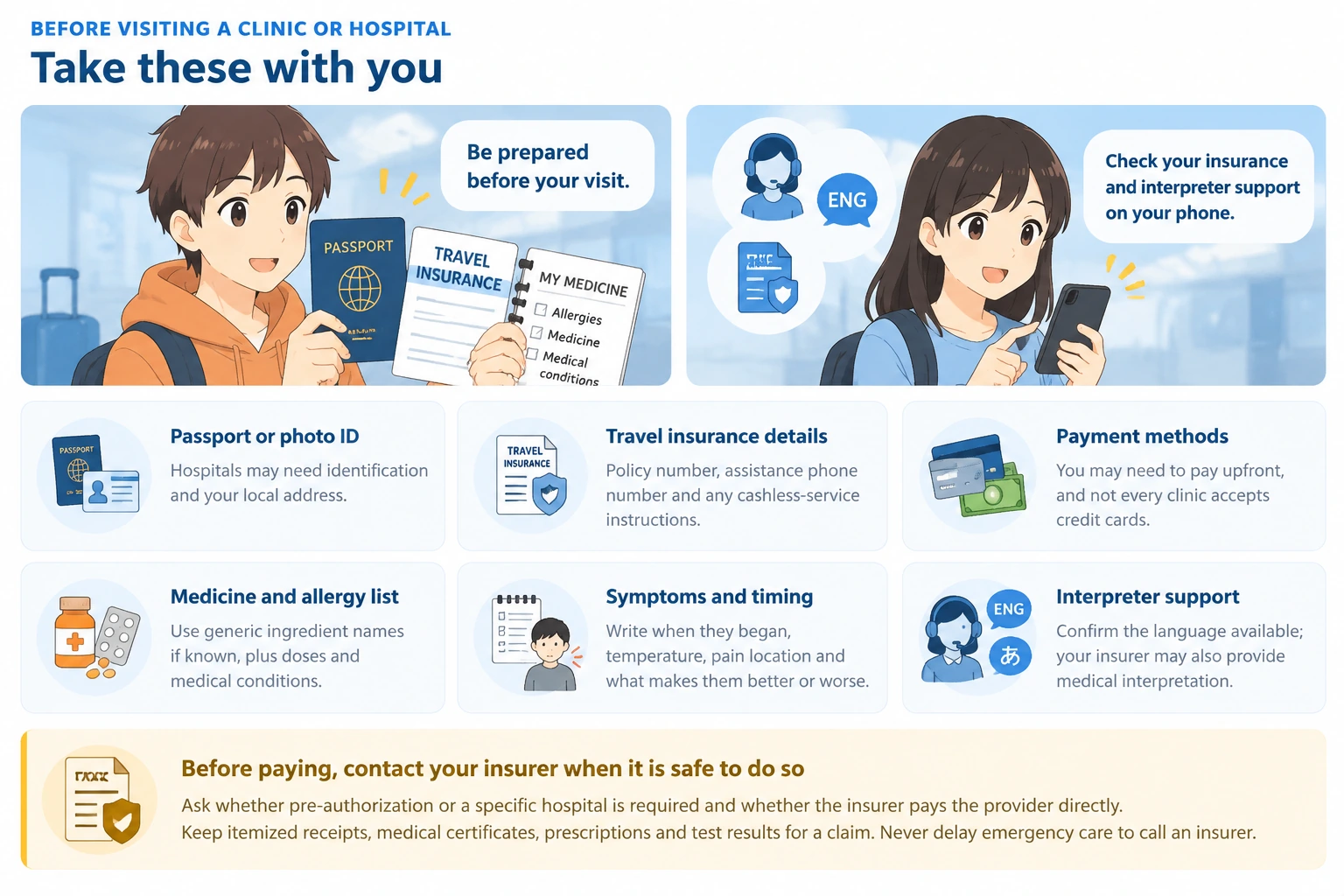
Before visiting a clinic or hospital
Take these with you
Passport or photo IDHospitals may need identification and your local address.Travel insurance detailsPolicy number, assistance phone number and any cashless-service instructions.Payment methodsYou may need to pay upfront, and not every clinic accepts credit cards.Medicine and allergy listUse generic ingredient names if known, plus doses and medical conditions.Symptoms and timingWrite when they began, temperature, pain location and what makes them better or worse.Interpreter supportConfirm the language available; your insurer may also provide medical interpretation.
Before paying, contact your insurer when it is safe to do so
Ask whether pre-authorization or a specific hospital is required and whether the insurer pays the provider directly. Keep itemized receipts, medical certificates, prescriptions and test results for a claim. Never delay emergency care to call an insurer.
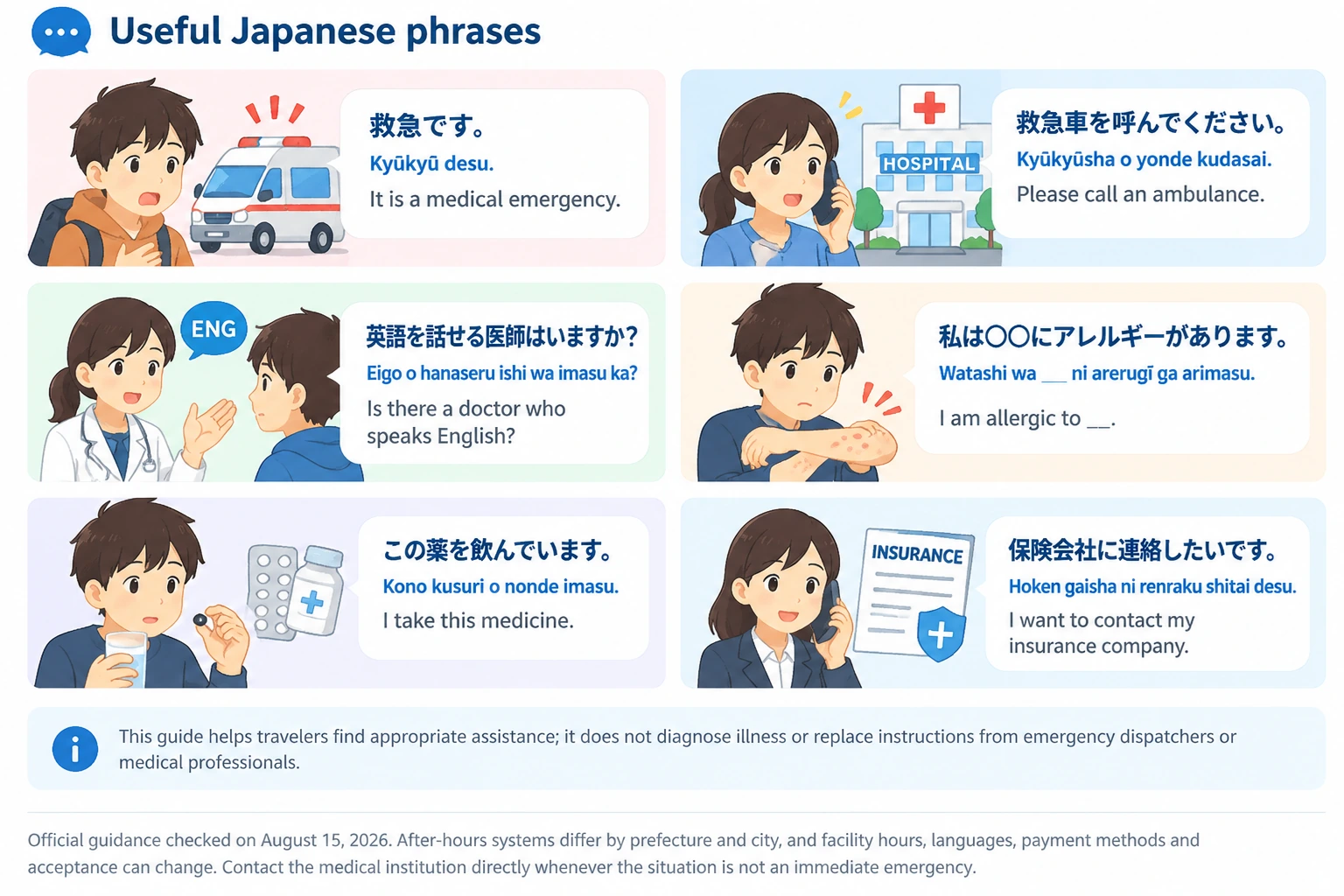
Useful Japanese phrases
Tap the illustration to view it at full size. The phrases below remain selectable text.
救急です。Kyūkyū desu.It is a medical emergency.
救急車を呼んでください。Kyūkyūsha o yonde kudasai.Please call an ambulance.
英語を話せる医師はいますか?Eigo o hanaseru ishi wa imasu ka?Is there a doctor who speaks English?
私は〇〇にアレルギーがあります。Watashi wa ___ ni arerugī ga arimasu.I am allergic to ___.
この薬を飲んでいます。Kono kusuri o nonde imasu.I take this medicine.
保険会社に連絡したいです。Hoken gaisha ni renraku shitai desu.I want to contact my insurance company.
This guide helps travelers find appropriate assistance; it does not diagnose illness or replace instructions from emergency dispatchers or medical professionals.
Official guidance checked on August 15, 2026. After-hours systems differ by prefecture and city, and facility hours, languages, payment methods and acceptance can change. Contact the medical institution directly whenever the situation is not an immediate emergency.
Useful links
Open official medical resources
Official resources come first. Links open in a new tab.